Our paper on the defomability of red blood cells take from patients with Birdshot
Chorioretinopathy has been published as R. Agrawal et al 'Non-occlusive retinal vascular inflammation and role of red blood cell deformability in birdshot chorioretinopathy', Ocular Immunology and Inflammation doi:10.1080/09273948.2018.1485959 (2018).
From the abstract:
Purpose: To investigate differences in red blood cell (RBC) deformability between birdshot chorioretinopathy (BCR) subjects and matched controls, and to postulate its relationship with lack of vascular occlusion in BCR.
Methods: In a single center, prospective, non-randomized mechanistic study, blood samples were collected from eight healthy controls and nine BCR patients, and subjected to biochemical and hematological tests, as well as RBC indices assessment using dual-beam optical tweezers.
Results: The mean age of the controls was 52.37 ± 10.70 years and BCR patients was 53.44 ± 12.39 years. Initial cell size (Io) for the controls was 8.48 ± 0.25 μm and 8.87 ± 0.31 μm for BCR RBCs (p = 0.014). The deformability index (DI) for the controls was 0.066 ± 0.02 and that for BCR RBCs was 0.063 ± 0.03 (p = 0.441).
Conclusion: There was no statistically significant difference in DI between RBCs from BCR and healthy controls. This may explain the rare occurrence of retinal vascular occlusion despite the underlying vasculitic pathophysiology of BCR.
Our work on trapping 2D materials has been published as M. G. Donato, E. Messina, A. Foti, T. Smart, P. H. Jones, M. A. Iatì, R. Saija, P. G. Gucciardi & O. M. Maragò. 'Optical trapping and optical force positioning of two dimensional materials', Nanoscale 10 1245-1255 (2018).

From the abstract: In recent years, considerable effort has been devoted to the synthesis
and characterization of two-dimensional materials. Liquid phase
exfoliation (LPE) represents a simple, large-scale method to exfoliate
layered materials down to mono- and few-layer flakes. In this context,
the contactless trapping, characterization, and manipulation of
individual nanosheets hold perspectives for increased accuracy in flake
metrology and the assembly of novel functional materials. Here, we use
optical forces for high-resolution structural characterization and
precise mechanical positioning of nanosheets of hexagonal boron nitride,
molybdenum disulfide, and tungsten disulfide obtained by LPE. Weakly
optically absorbing nanosheets of boron nitride are trapped in optical
tweezers. The analysis of the thermal fluctuations allows a direct
measurement of optical forces and the mean flake size in a liquid
environment. Measured optical trapping constants are compared with
T-matrix light scattering calculations to show a quadratic size scaling
for small size, as expected for a bidimensional system. In contrast,
strongly absorbing nanosheets of molybdenum disulfide and tungsten
disulfide are not stably trapped due to the dominance of radiation
pressure over the optical trapping force. Thus, optical forces are used
to pattern a substrate by selectively depositing nanosheets in short
times (minutes) and without any preparation of the surface. This study
will be useful for improving ink-jet printing and for a better
engineering of optoelectronic devices based on two-dimensional
materials.
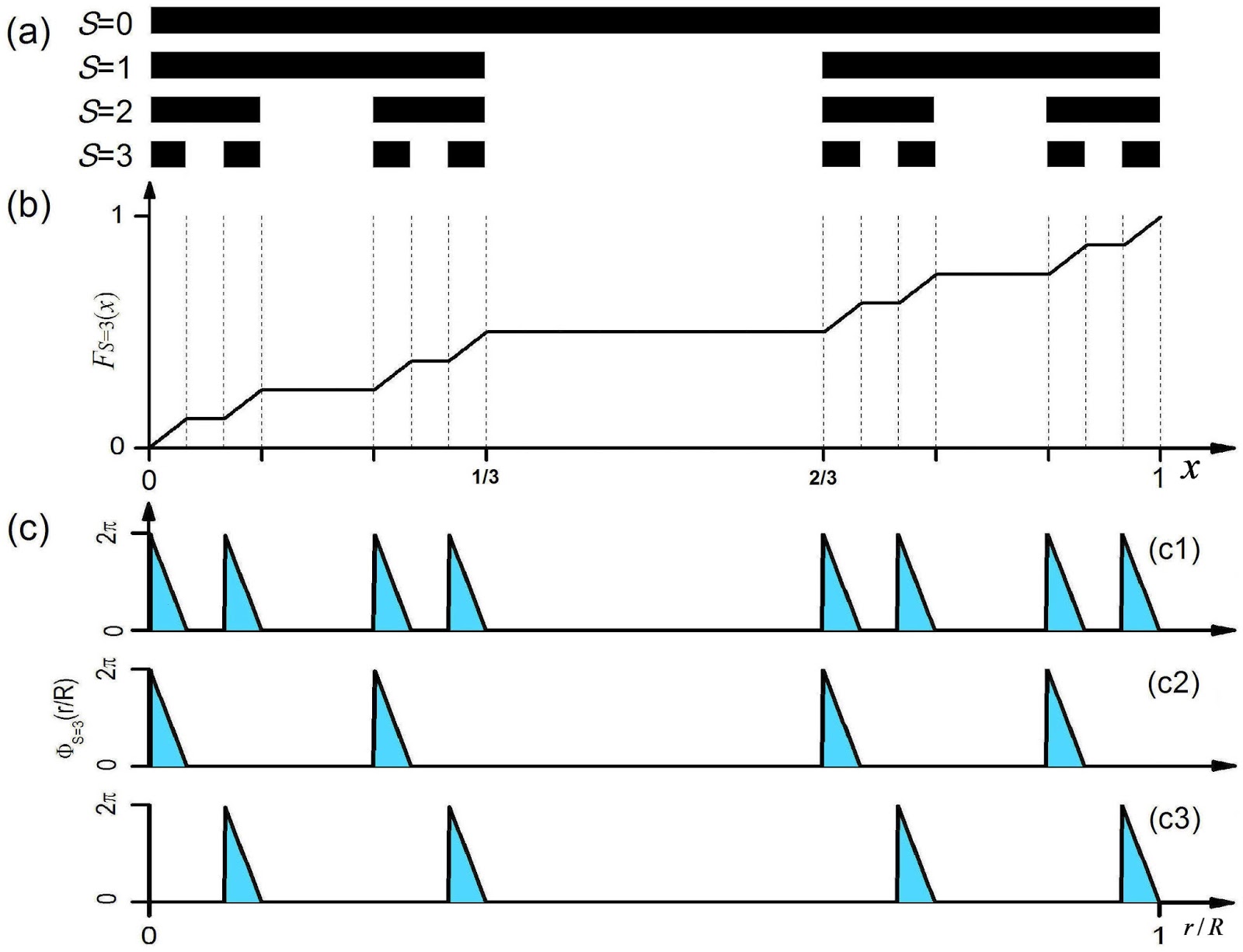
Our work on the focal volume structure of spatially inhomogeneous polarization beams focused by a novel 'fractal' axicon has been published as Zhirong Liu, Kelin Huang, Xun Wang & P. H. Jones 'Tight focusing of radially polarized beams modulated by a fractal conical lens' Opt. Commun. 402 231-237 (2017).

From the abstract: A novel high numerical aperture (NA) focusing system with a fractal
conical lens (FCL) is proposed, and tight focusing of radially polarized
beams through the proposed optical system is investigated theoretically
and numerically. The influence of several relevant factors, including
the FCL’s stage , objective lens’ NA, and truncation parameter , on the targeted beam’s focusing characteristics in the focal region is discussed in detail. It is found that, when a FCL with S≥0
is employed, position of the major focal point would shift from the
geometric focal point, and the focused intensity distributions cannot
maintain symmetrical about the focus any more, although they present
different profiles for various truncation parameters . When ,
multiple focal points can be generated, i.e., a single major focus and a
series of subsidiary foci surrounding it along the optical axis, which
form a focal region. These unique focusing characteristics with a FCL
are remarkably different from that of without a FCL. The fascinating
findings here may be taken advantage of when using radially polarized
beams in exploiting new-type optical tweezers and making use of a FCL.
Our theoretical study of optical binding effects between nonspherical particles has been published as S. H. Simpson, P. Zemánek, O. M. Maragò, P. H. Jones & S. Hanna. 'Optical binding of nanowires', Nano Letters 17 3485-3492 (2017).

From the abstract: Multiple scattering of light induces structured interactions, or optical binding forces, between collections of small particles. This has been extensively studied in the case of microspheres. However, binding forces are strongly shape dependent: here, we turn our attention to dielectric nanowires. Using a novel numerical model we uncover rich behavior. The extreme geometry of the nanowires produces a sequence of stationary and dynamic states. In linearly polarized light, thermally stable ladder-like structures emerge. Lower symmetry, sagittate arrangements can also arise, whose configurational asymmetry unbalances the optical forces leading to nonconservative, translational motion. Finally, the addition of circular polarization drives a variety of coordinated rotational states whose dynamics expose fundamental properties of optical spin. These results suggest that optical binding can provide an increased level of control over the positions and motions of nanoparticles, opening new possibilities for driven self-organization and heralding a new field of self-assembling optically driven micromachines.
Our work on acoustic and optical trapping of microbubbles has been published as G. Memoli, C. R. Fury, P. N. Gélat, K. O. Baxter & P. H. Jones. 'Acoustic force measurements on polymer-coated microbubbles in a microfluidic device', Journal of the Acoustical Society of America 141 3346 (2017).

From the abstract: This work presents an acoustofluidic device for manipulating coated microbubbles, designed for the simultaneous use of optical and acoustical tweezers. A comprehensive characterization of the acoustic pressure in the device is presented, obtained by the synergic use of different techniques in the range of acoustic frequencies where visual observations showed aggregation of microbubbles. In absence of bubbles, the combined use of laser vibrometry and finite element modelling supported a non-invasive measurement of the acoustic pressure and an enhanced understanding of the system resonances. Calibrated holographic optical tweezers were then used for a direct measurement of the acoustic forces acting on an isolated microbubble at low driving pressures and to confirm the spatial distribution of the acoustic field. This allowed quantitative pressure measurements by particle tracking using polystyrene beads and an evaluation of the related uncertainties. The extension of the tracking technique to polymer-coated microbubbles allowed acoustic force measurements at higher pressures, highlighting four peaks in the acoustic response of the device. Results and methodologies are relevant to acoustofluidic applications requiring a precise characterization of the acoustic field and, in general, to biomedical applications with microbubbles or deformable particles.
Our work on a novel optical trapping system using fractal optics and spatially inhomogneous polarisation of light has been published as Zhirong Liu and P. H. Jones, 'Fractal conical lens optical tweezers', IEEE Photonics Journal 9 6500111 (2017)
 From the abstract: We propose a novel optical tweezers composed of an annular beam with
alternate radially and azimuthally polarized rings modulated by a
fractal conical lens (FCL) and demonstrate its optical forces on
Rayleigh dielectric particles both analytically and numerically. Owing
to the optical system's particular focusing properties, which could
generate a dark-centered or peak-centered intensity distribution in the
focal region when selecting an appropriate truncation parameter in front
of the focusing lens, the proposed FCL optical tweezers could
selectively trap and manipulate dielectric mesoscopic particles with
low- or high-refractive indices by appropriately adjusting the radius of
the pupil or the beam. Finally, the stability conditions for effective
trapping and manipulation Rayleigh particles are analyzed.
From the abstract: We propose a novel optical tweezers composed of an annular beam with
alternate radially and azimuthally polarized rings modulated by a
fractal conical lens (FCL) and demonstrate its optical forces on
Rayleigh dielectric particles both analytically and numerically. Owing
to the optical system's particular focusing properties, which could
generate a dark-centered or peak-centered intensity distribution in the
focal region when selecting an appropriate truncation parameter in front
of the focusing lens, the proposed FCL optical tweezers could
selectively trap and manipulate dielectric mesoscopic particles with
low- or high-refractive indices by appropriately adjusting the radius of
the pupil or the beam. Finally, the stability conditions for effective
trapping and manipulation Rayleigh particles are analyzed.
Our paper on the optical trapping forces of a poarization-structured beam focused by a fractal (Devil's) lens has been published as Zhirong Liu and P. H. Jones, 'Radiation forces acting upon a
Rayleigh particle by highly focused alternate radially- and
azimuthally-polarized beams modulated by a Devil's Lens', Journal of the Optical Society of America A 33 2501-2508 (2016).
 From the abstract: We propose and demonstrate a novel high numerical aperture (NA) focusing
system composed of an annular beam with alternate radially and
azimuthally polarized rings, focused by a devil’s lens (DL), and further
investigate its radiation forces acting upon a Rayleigh particle both
analytically and numerically. Strongly focused cylindrical vector beams
produce either dark-centered or peak-centered intensity distributions
depending on the state of polarization, whereas the DL produces a series
of foci along the propagation direction. We exploit these focusing
properties and show that by selecting an appropriate truncation
parameter in front of the focusing lens, the proposed optical focusing
system can selectively trap and manipulate dielectric micro-particles
with low or high refractive indices by simply adjusting the radius of
the pupil or the beam. Finally, the stability conditions for effectively
trapping and manipulating Rayleigh particles are analyzed. The results
obtained in this work are of interest in possible applications in
optical confinement and manipulation, sorting micro-particles, and
making use of a DL.
From the abstract: We propose and demonstrate a novel high numerical aperture (NA) focusing
system composed of an annular beam with alternate radially and
azimuthally polarized rings, focused by a devil’s lens (DL), and further
investigate its radiation forces acting upon a Rayleigh particle both
analytically and numerically. Strongly focused cylindrical vector beams
produce either dark-centered or peak-centered intensity distributions
depending on the state of polarization, whereas the DL produces a series
of foci along the propagation direction. We exploit these focusing
properties and show that by selecting an appropriate truncation
parameter in front of the focusing lens, the proposed optical focusing
system can selectively trap and manipulate dielectric micro-particles
with low or high refractive indices by simply adjusting the radius of
the pupil or the beam. Finally, the stability conditions for effectively
trapping and manipulating Rayleigh particles are analyzed. The results
obtained in this work are of interest in possible applications in
optical confinement and manipulation, sorting micro-particles, and
making use of a DL.