
Showing posts with label fractal optics. Show all posts
Showing posts with label fractal optics. Show all posts
Friday, 30 June 2017
Paper published in Optics Communications
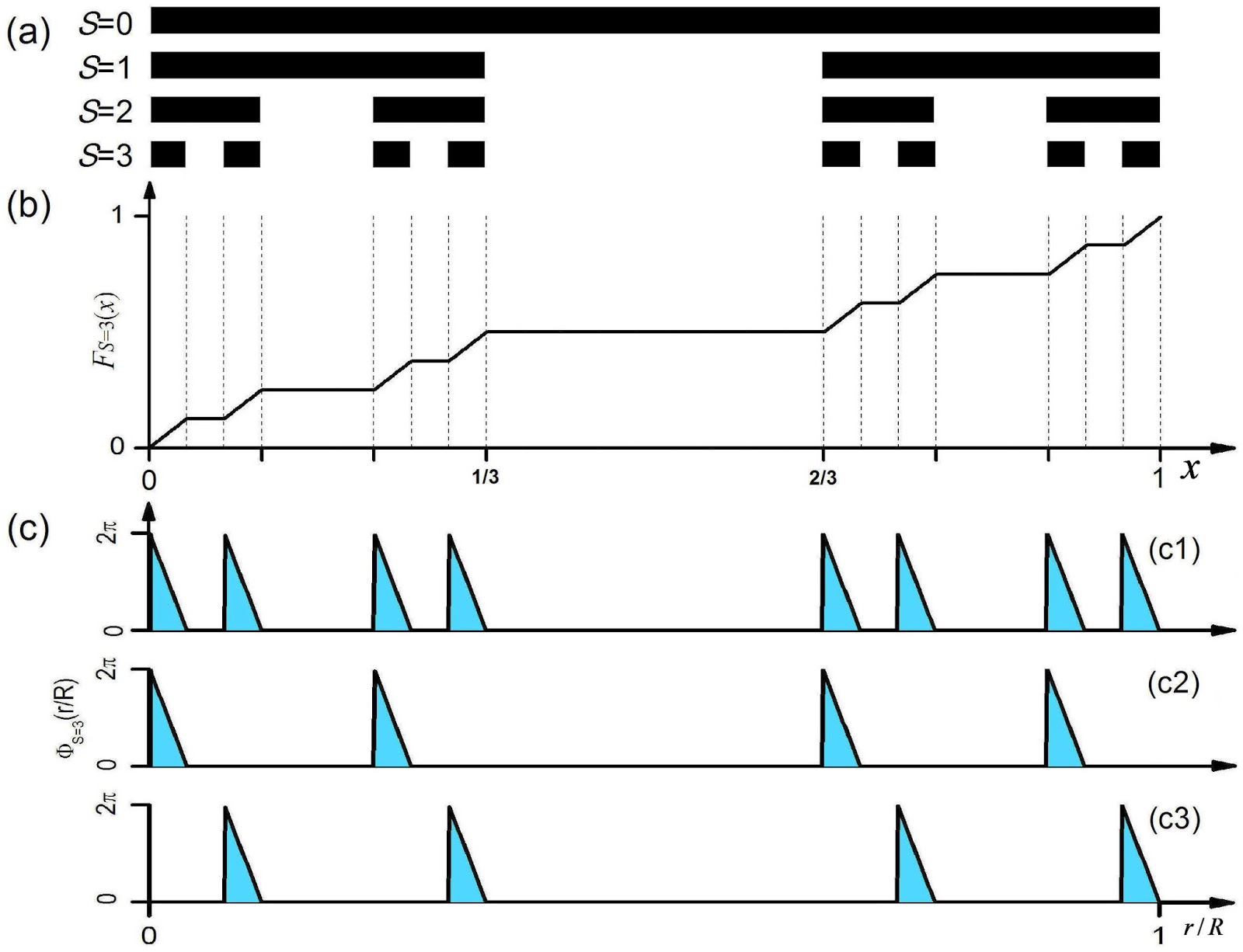
Our work on the focal volume structure of spatially inhomogeneous polarization beams focused by a novel 'fractal' axicon has been published as Zhirong Liu, Kelin Huang, Xun Wang & P. H. Jones 'Tight focusing of radially polarized beams modulated by a fractal conical lens' Opt. Commun. 402 231-237 (2017).
 From the abstract: A novel high numerical aperture (NA) focusing system with a fractal
conical lens (FCL) is proposed, and tight focusing of radially polarized
beams through the proposed optical system is investigated theoretically
and numerically. The influence of several relevant factors, including
the FCL’s stage , objective lens’ NA, and truncation parameter , on the targeted beam’s focusing characteristics in the focal region is discussed in detail. It is found that, when a FCL with S≥0
is employed, position of the major focal point would shift from the
geometric focal point, and the focused intensity distributions cannot
maintain symmetrical about the focus any more, although they present
different profiles for various truncation parameters . When ,
multiple focal points can be generated, i.e., a single major focus and a
series of subsidiary foci surrounding it along the optical axis, which
form a focal region. These unique focusing characteristics with a FCL
are remarkably different from that of without a FCL. The fascinating
findings here may be taken advantage of when using radially polarized
beams in exploiting new-type optical tweezers and making use of a FCL.


Tuesday, 7 February 2017
Paper published in IEEE Photonics Journal
Our work on a novel optical trapping system using fractal optics and spatially inhomogneous polarisation of light has been published as Zhirong Liu and P. H. Jones, 'Fractal conical lens optical tweezers', IEEE Photonics Journal 9 6500111 (2017)
 From the abstract: We propose a novel optical tweezers composed of an annular beam with
alternate radially and azimuthally polarized rings modulated by a
fractal conical lens (FCL) and demonstrate its optical forces on
Rayleigh dielectric particles both analytically and numerically. Owing
to the optical system's particular focusing properties, which could
generate a dark-centered or peak-centered intensity distribution in the
focal region when selecting an appropriate truncation parameter in front
of the focusing lens, the proposed FCL optical tweezers could
selectively trap and manipulate dielectric mesoscopic particles with
low- or high-refractive indices by appropriately adjusting the radius of
the pupil or the beam. Finally, the stability conditions for effective
trapping and manipulation Rayleigh particles are analyzed.
 From the abstract: We propose a novel optical tweezers composed of an annular beam with
alternate radially and azimuthally polarized rings modulated by a
fractal conical lens (FCL) and demonstrate its optical forces on
Rayleigh dielectric particles both analytically and numerically. Owing
to the optical system's particular focusing properties, which could
generate a dark-centered or peak-centered intensity distribution in the
focal region when selecting an appropriate truncation parameter in front
of the focusing lens, the proposed FCL optical tweezers could
selectively trap and manipulate dielectric mesoscopic particles with
low- or high-refractive indices by appropriately adjusting the radius of
the pupil or the beam. Finally, the stability conditions for effective
trapping and manipulation Rayleigh particles are analyzed.
Subscribe to:
Posts (Atom)