A PhD studentship is available to start in September 2014 on a project entitled Membrane engineering of artificial lipid vesicles. The goal of this project is to use optical tweezers to probe the mehanical properties of biomimetic vesicles undergoing temperature or light-induced phase or structural transformation, and to use the results of these studies to engineer membrane materials with properties optimised for applications including controlled drug release and microreactors.
Experimental work will be carried out in the Optical Tweezers Group in the Department of Physics & Astronomy at UCL and in the Biological Soft Matter Group in the School of Materials Science at the Japan Advanced Institute of Science & Technology (JAIST). The project is jointly supervised by Dr Phil Jones (UCL) and Dr Tsutomu Hamada (JAIST).
The studentship will pay a stipend and fees at the rate applicable for UK/EU students for three years. The student will be registered for a PhD at UCL where they will spend the first and third years. The second year of the PhD will be spent at JAIST.
Please contact Dr Phil Jones for further details or to express an interest.
Monday, 16 December 2013


Monday, 2 December 2013
AMOP Physics Open Day
The
Atomic Molecular Optical and Positron Physics group will be holding
an Open Day on Wednesday December 4th 2013 at 13:00. The Open Day will be held in rooms A1 and E7 located on the Physics building on UCL's main Gower Street Campus.
The agenda of the day is:
13:00 - 15:00 Short research presentations by AMOPP faculty (A1)
The agenda of the day is:
15:00 - 18:00 Poster presentations by research groups (E7)
Monday, 11 November 2013
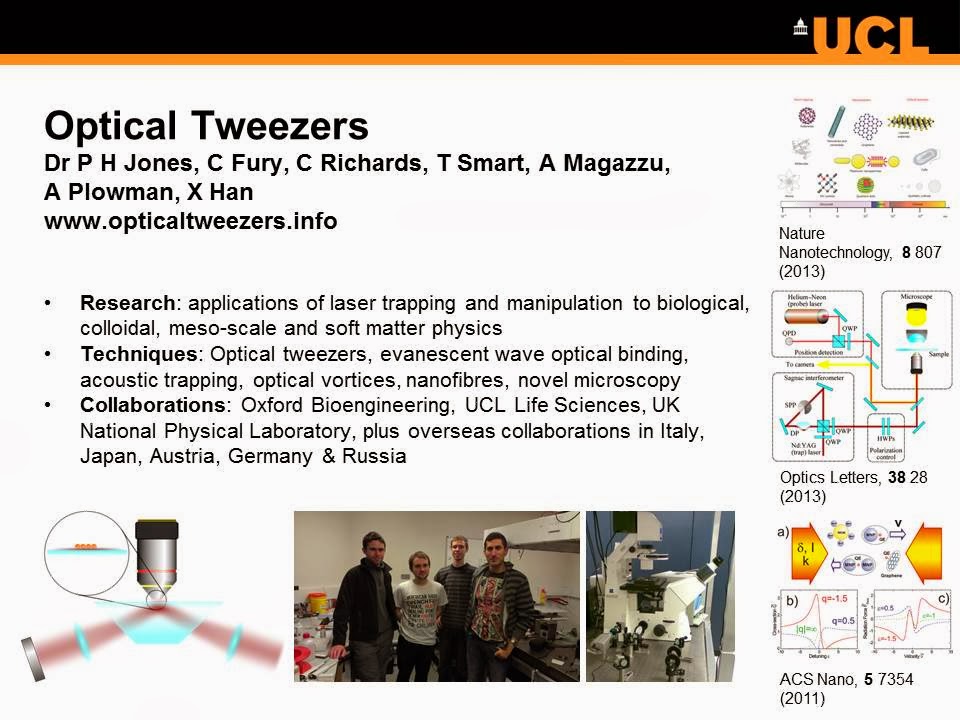
Review paper in Nature Nanotechnology
'Optical
trapping and manipulation of nanostructures' has been published in Nature Nanotechnology 8 807-819 (2013).
 From the abstract: Optical trapping and manipulation of micrometre-sized particles was
first reported in 1970. Since then, it has been successfully implemented
in two size ranges: the subnanometre scale, where light–matter
mechanical coupling enables cooling of atoms, ions and molecules, and
the micrometre scale, where the momentum transfer resulting from light
scattering allows manipulation of microscopic objects such as cells. But
it has been difficult to apply these techniques to the intermediate —
nanoscale — range that includes structures such as quantum dots,
nanowires, nanotubes, graphene and two-dimensional crystals, all of
crucial importance for nanomaterials-based applications. Recently,
however, several new approaches have been developed and demonstrated for
trapping plasmonic nanoparticles, semiconductor nanowires and carbon
nanostructures. Here we review the state-of-the-art in optical trapping
at the nanoscale, with an emphasis on some of the most promising
advances, such as controlled manipulation and assembly of individual and
multiple nanostructures, force measurement with femtonewton resolution,
and biosensors.

Wednesday, 30 October 2013
Bragg Lecture 2013 by Prof Paul Chaikin
The 2013 Bragg Lecture will take place on Wed 30 October, and will be given by Prof Paul Chaikin (New York University) on Some small steps towards artificial life.
Abstract: The properties we often associate with living things are motility, metabolism, self-replication and evolution. According to the Nobel Laureate Richard Feynman: “What I can’t create, I don’t understand”. We thought we’d give it a shot - understanding life - and in the process we’ve made two different systems, one that exhibits both autonomous motility and metabolism and another which is the first artificial system that can replicate arbitrarily designed motifs. The first system, artificial swimmers, provides insight into many natural phenomena such as a flocking of birds and schooling of fish. The second system uses diurnal cycles of temperature and light and at present is doubling each cycle, growing exponentially. It provides a new way of producing many, many copies of nanoscale devices and may give insights into the origin of conventional life on earth. We even have initiated an elementary form of evolution.
Abstract: The properties we often associate with living things are motility, metabolism, self-replication and evolution. According to the Nobel Laureate Richard Feynman: “What I can’t create, I don’t understand”. We thought we’d give it a shot - understanding life - and in the process we’ve made two different systems, one that exhibits both autonomous motility and metabolism and another which is the first artificial system that can replicate arbitrarily designed motifs. The first system, artificial swimmers, provides insight into many natural phenomena such as a flocking of birds and schooling of fish. The second system uses diurnal cycles of temperature and light and at present is doubling each cycle, growing exponentially. It provides a new way of producing many, many copies of nanoscale devices and may give insights into the origin of conventional life on earth. We even have initiated an elementary form of evolution.
Wednesday, 23 October 2013
Marios Sergides PhD viva
Congratulations to Optical Tweezers PhD student Marios Sergides who has successfully defended his PhD thesis on Optical manipulation of micro-and nanoparticles using evansecent fields. Marios will be leaving the group to start a postdoc with a Japan Sciety for the Promotion of Science (JSPS) Postdoctoral Fellowship at the Okinawa Institute of Science and Technology (OIST), Japan, in the Light-Matter Interactions Unit under the supervision of Dr Sile Nic Chormaic. Many thanks to Dr Mark Ellerby (UCL) and Dr Valeria Garbin (Imperial College) for acting as examiners.
Well done Dr Sergides, and good luck in Japan!
Well done Dr Sergides, and good luck in Japan!
SPIE Conference Proceedings
Proceedings from the SPIE Optics + Photonics 2013 conference have been published. These include a paper containing calculations by Stephen Simpson (Bristol University) based on our optical binding experiments: S. H. Simpson, P. H. Jones, O. M. Maragò, S. Hanna & M. J. Miles. 'Optical binding of nanowires in counter-propagating beams’, Proc SPIE 8810 Optical Trapping and Optical Micromanipulation X, 881026, doi: 10.1117/12.2024466 (2013).
From the abstrast: We present a computational model for the simulation of optically interacting nano-structures immersed in a viscous fluid. In this scheme, nanostructures are represented by aggregates of small spheres. All optical and hydrodynamic interactions, including thermal fluctuations, are included. As an example, we consider optical binding of dielectric nanowires in counterpropagating plane waves. In particular, the formation of stable, ladder like structures, is demonstrated. In these arrangements, each nanowire lies parallel to the polarization direction of the beams, with their centres of mass colinear.
From the abstrast: We present a computational model for the simulation of optically interacting nano-structures immersed in a viscous fluid. In this scheme, nanostructures are represented by aggregates of small spheres. All optical and hydrodynamic interactions, including thermal fluctuations, are included. As an example, we consider optical binding of dielectric nanowires in counterpropagating plane waves. In particular, the formation of stable, ladder like structures, is demonstrated. In these arrangements, each nanowire lies parallel to the polarization direction of the beams, with their centres of mass colinear.
Tuesday, 1 October 2013
New Group Members
At the start of the new academic year we are welcoming several new members to the Optical Tweezers Group. Chris Richards and Tom Smart are new PhD students who will both be working on the project Exploring Stochastic Thermodynamics with Optical Traps. Chris is a UCL Physics graduate, and worked in the group last year for his MSci project. Tom comes to us from Leeds University via IoP publishing where he worked for 12 months in the editorial office.
Alessandro Magazzu has also joined us as a visiting student for one month under the EU COST Action MP1205 on Optofluidics. Alessandro is in the second year of his PhD at Università degli Studi di Messina, Sicily, and is supervised by Dr Onofrio Marago at the NanoSoft Lab, IPCF-CNR.
Finally Adam Plowman is joining us for his MSci project to investigate the dynamics of artificial micoswimmers.
Subscribe to:
Posts (Atom)